

è da poco che mi sono buttato su queto piccolo gingillo ma dalle mille potenzialità..
Per ora mi limito a fare dei piccoli circuiti e niente di più diciamo che sto studiando le funzionalità..
quello che mi è venuto in mente è trasformarlo in una centralina drum-midi..già su internet si trova qual cosa ma a pochi canali..diciamo nulla di che ma io forrei fare una cosa completa cominciando da otto canali..
io sono in possesso del modello uno per intenderci:
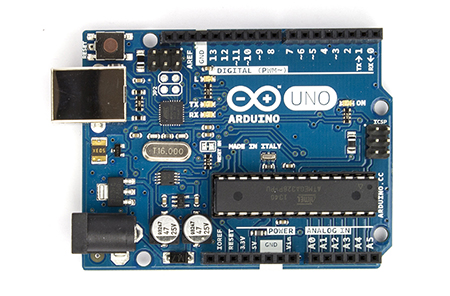
ho provato uno schema di programazzione girando per internet ma non riesco a farlo funzionare!! qualcuno di voi lo sa programmare ? che vi pare come idea?
vi scrivo le linee comando che ho trovato girando per la rete :
Proto1
// Variables:
byte note = 0; // The MIDI note value to be played
void setup() {
// Set MIDI baud rate:
Serial.begin(31250);
}
void loop() {
// play notes from F#-0 (30) to F#-5 (90):
for (note = 30; note < 90; note ++) {
//Note on channel 1 (0x90), some note value (note), middle velocity (0x45):
noteOn(0x90, note, 0x45);
delay(100);
//Note on channel 1 (0x90), some note value (note), silent velocity (0x00):
noteOn(0x90, note, 0x00);
delay(100);
}
}
// plays a MIDI note. Doesn't check to see that
// cmd is greater than 127, or that data values are less than 127:
void noteOn(byte cmd, byte data1, byte data2) {
Serial.write(cmd);
Serial.write(data1);
Serial.write(data2);
}
const int switchPin = 10; // The switch is on Arduino pin 10
const int middleC = 60; // Middle C (MIDI note value 60) is the lowest note we'll play
const int LEDpin = 13; // Indicator LED
// Variables:
byte note = 0; // The MIDI note value to be played
int AnalogValue = 0; // value from the analog input
int lastNotePlayed = 0; // note turned on when you press the switch
int lastSwitchState = 0; // state of the switch during previous time through the main loop
int currentSwitchState = 0;
void setup() {
// set the states of the I/O pins:
pinMode(switchPin, INPUT);
pinMode(LEDpin, OUTPUT);
// Set MIDI baud rate:
Serial.begin(31250);
blink(3);
}
void loop() {
// My potentiometer gave a range from 0 to 1023:
AnalogValue = analogRead(0);
// convert to a range from 0 to 127:
note = AnalogValue/8;
currentSwitchState = digitalRead(switchPin);
// Check to see that the switch is pressed:
if (currentSwitchState == 1) {
// check to see that the switch wasn't pressed last time
// through the main loop:
if (lastSwitchState == 0) {
// set the note value based on the analog value, plus a couple octaves:
// note = note + 60;
// start a note playing:
noteOn(0x90, note, 0x40);
// save the note we played, so we can turn it off:
lastNotePlayed = note;
digitalWrite(LEDpin, HIGH);
}
}
else { // if the switch is not pressed:
// but the switch was pressed last time through the main loop:
if (lastSwitchState == 1) {
// stop the last note played:
noteOn(0x90, lastNotePlayed, 0x00);
digitalWrite(LEDpin, LOW);
}
}
// save the state of the switch for next time
// through the main loop:
lastSwitchState = currentSwitchState;
}
// plays a MIDI note. Doesn't check to see that
// cmd is greater than 127, or that data values are less than 127:
void noteOn(byte cmd, byte data1, byte data2) {
Serial.write(cmd);
Serial.write(data1);
Serial.write(data2);
}
// Blinks an LED 3 times
void blink(int howManyTimes) {
int i;
for (i=0; i< howManyTimes; i++) {
digitalWrite(LEDpin, HIGH);
delay(100);
digitalWrite(LEDpin, LOW);
delay(100);
}
}
fonte : http://itp.nyu.edu/physcomp/Labs/MIDIOutput




 .
.
 Grazie man
 c'è pure tutta una discussione a riguardo nel forum:


 .... forse è eccessivo
  , magari lo diventerà se riuscirò a trasformarlo in una centralina a tutti gli effetti aggiungendo la possibilità di produrre dei suoni, per adesso l'importante è "unire" gli sforzi di tutti. Per questo mi sono permesso di intromettermi con questo "messaggio promozionale". Le idee di tutti sono sempre bene accette ma se cerchiamo di concentrarci in una direzione comune secondo me otterremo un risultato migliore
  .
.